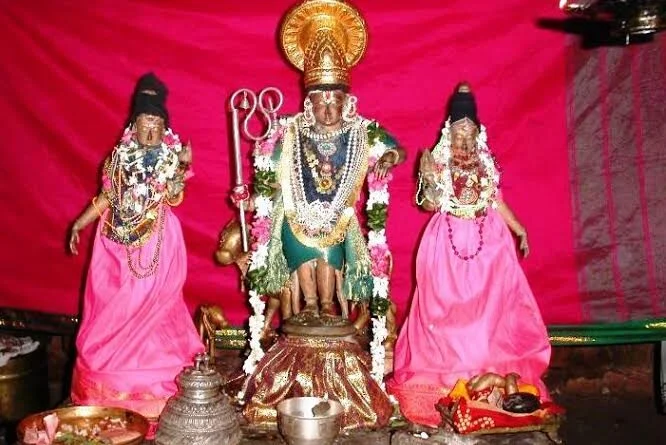
Rukmini and Satyabhāmā as Ubhaya-Nachiyars
P. Desikan
छायायां पारिजातस्य हेमसिंहासनोपरि
आसीनमम्बुदश्याममायताक्षमलङ्कृतम् ।
चन्द्राननं चतुर्बाहुं श्रीवत्साङ्कित वक्षसं
रुक्मिणी सत्यभामाभ्यां सहितं कृष्णमाश्रये ॥
Lying on a bed of arrows while calmly awaiting his death, the grand old Bhīṣma pitamaha of the Kurus chants Sri Vishnu Sahasranama, the thousand names of Nārāyaṇa for the benefit of Yudhisthira, who is listening with rapt attention. Before beginning the actual recital of the sacred names, Bhīṣma goes into the dhyāna mode, visualizing the Lord in his yogic seat provided by Adisesha above the waves of the Ocean of Milk.
As the dhyāna rolls on he remembers that Nārāyaṇa or Vishnu was not merely in that heavenly abode. As Krishna, he was then and there available to all of them on earth as well. Bhīṣma chooses to visualize him under a Parijata tree, seated on a golden throne with his main consorts Rukmini and Sathyabhama.
Bhīṣma most certainly recognizes in them Mother Sridevi and Mother Bhudevi. Krishna appears in this vision to have four arms as in his original Vishnu form. The holy Śrīvatsa mark too is clearly visible on his chest.
This final dhyanashlokam of Sri Vishnu Sahasranama thus conveys to us the total identity of Bhagavan Vishnu with his avataras in the minds of his devotees. The twelve Azhwars, who sang his glory in Tamil while visiting several Vishnu temples then available, also did not distinguish Nārāyaṇa from his avataras.
Individual pasurams they sang , while ostensibly meant for the deity being visited, are simultaneously found to refer to Bhagavan’s leelas/exploits in any one or more of the avataras, Rama and Krishna being the most popular among them, and Krishna having a slight edge even over Rama.
Many pasurams (songs) of Periyaazhvar, for instance, enjoy Krishna sporting as a child, and many of his as well as Thirumangai Azhwar’s songs talk about Krishna’s youthful dalliances with cowherd maidens.
The Azhwars lived in Tamil speaking areas of South India in the 10th century CE and earlier. While the two heavenly abodes of Nārāyaṇa, the first, Paramapadam also called Vaikuntham and the second known as Tirupparkadal, inspired some of their pasurams, they also soulfully sang about Bhagavan in 106 earthbound temples.
These places are called Divyadesams by Tamil Vishnubhaktas and all the songs put together, numbering four thousand, are lovingly referred to by them as Divyaprabandham. (As Swami Desika indicated in his special Tamil verse, the count becomes 4000, only when Madhurakavi Azhvar’s stuti of Nammazhvar and Thiruvarangaththamudanar’s Ramanujastuti are included!) A majority of the Divyadesams were in Tamil speaking South Indian regions for obvious reasons, but the Azhvars also undertook long trips to visit northern kṣetras associated with Vishnu’s avataras.
For Nammazhvar, who was in silent meditation under a tamarind tree in Tirukkurugur, there was no need to go to the kṣetras. Nārāyaṇa gave him inner vision to experience detailed darśana of his archa murtis in all kṣetras.
The sahasranama-dhyanashlokam very clearly sees Krishna as Vishnu, as there are references to four hands and his Śrīvatsa mark. It refers to him simultaneously as being together with Rukmini and Satyabhāmā thus identifying them with Sriidevi and Bhudevi who are present along with Perumal as Ubhaya Nachiyars in most Perumal temples. It would therefore be natural for us to expect that especially in divyadesams where the main deity is Krishna, the two ubhayanachiyars could as well be Rukmini and Satyabhāmā, instead of Sridevi and Bhudevi.
The expectation is satisfied in Tirukkavalampadi. The temple has a simple, charming appearance and has a flower garden, which may have also held the parijata tree claimed by the sthalapurana as having been planted by Sri Krishna and Satyabhāmā. Tirumangai Azhvar writes in Perya Thirumozhi-4, 6th decade, 8th verse about the advent of the divine tree thus:
ஏவிளங்கன்னிக்காகி இமையவர் கோனைச்செற்று,
காவளம் கடிதிறுத்துக் கற்பகம் கொண்டு போந்தாய்,
பூவளம் பொழில்கள் சூழ்ந்த புரந்தரன் செய்த நாங்கைக்
காவளம்பாடி மேய கண்ணனே! களை கணீயே.
O Krishna! For the sake of young Satyabhāmā you subdued Indra, the King of Devas, and transferred the beautiful Kalpavriksha from heaven to her garden. You reside amid groves filled with flowers laid out by Purandara (Indra) himself in Nangur’s Kavalampadi. You are my sole refuge!
While the sthalapurana of the temple identifies the tree brought by Krishna as a Parijata, the Azhvar refers to it as Kalpavriksha. Tirukkavalampadi, where Gopalakrishna resides in Archa form along with Rukmini and Satyabhāmā as his ubhayanachiyars, became identified in the minds of Tirumangai Azhvar with Krishna’s Dwaraka and has developed alternate names like Dakshina Dwaraka and வண்துவராபதி. It is to be pointed out that in Dwaraka, where Sri Krishna ruled some 5000 years ago, the main deity in the temple, Dwarakanath gives darshan to his devotees accompanied only by one of his consorts, namely Rukmini.
In all Perumal temples of Tamilnadu (and also in other locations, where Vaikhanasa and Pancharatra agamas are followed), Mahalakshmi or Periya Piratti resides in her own chamber, the தாயார் தனிக்கோவில், with a name that aptly resonates with the name given to the Perumal.
She also resides as Sridevi, along with Perumal and Bhudevi, in the Perumal Sannidhi. This arrangement is true for the Utsava deities, who can go out to offer seva to the devotees, but may also in some temples be the norm for the Moolavar icons, who do not step out.
The name of Periya Piratti in Tirukkavalampadi is Sengamalavalli Thayar. She has her own space, which does not amount to a separate sannidhi. As has already been mentioned, Rukmini and Satyabhāmā have taken on the ubhayanachiyar role from Sridevi and Bhudevi in this temple.
The picture below shows Gopalakrishna in Tirukkavalampadi with his cow, calf and the guiding rope along with his consorts, who are Rukmini and Satyabhāmā.

This divyadesam is very near Tirukkuraiyalur, the birth place of Tirumangai Azhvar. There are indeed eleven divyadesa temples in the Tirunangur region, which owe their special status to the ecstatic devotional compositions of this Azhvar. However, out of these eleven temples, apart from Tirukkkavalampadi, we find reference to Krishna as Perumal only in kudamadukoothar kovil, where he is known as Chaturbhuja (four armed) Gopalan and in Tiru Parthan Palli, where he is known as Parthasarathy.
Amrutaghatavalli is the name of the Thayar in the former temple, while three nachiyars, Sridevi, Bhudevi and Neeladevi are present in the latter temple, both as Moolava and utsava nachiyar deities. Even among the remaining 93 kṣetras, only in Tiruppadagam, where the Perumal is Pandavadoothan, and in Gokulam where Krishna is known to have lived as the son of Nandagopa and Yashoda, the shrines have Rukmini and Satyabhāmā as the ubhayanachiyars.
In The famous Parthasarathy temple in Tiruvallikkeni, Rukmini Thayar stands along with Venkatakrishna Perumal in the Moolavar space. In Mathura (Vadamathurai), Satyabhāmā is worshipped along with Srikrishna.
Tirumangai Azhvar, Periyazhvar and Nammazhvar among the twelve Azhvars had poured out their Love of Perumal’s lotus feet in more than three thousand out of the four thousand verses of the Divya Prabandham. All three of them and the other nine Azhvars were ecstatic when Krishna became the object of their Pasurams, but they did not need to see the object of their love and his leelas through their outer eyes to corroborate the visions they were blessed with in their minds in abundance.
Thus every time they entered a Sriman Nārāyaṇa Sannidhi, they saw Perumal in whichever way their devoted imaginations led them, and if they saw Krishna parivar more often than others, it was not necessary that the deity was in fact a Krishna form, nor was it necessary for Rukmini and Satyabhāmā to be in attendance in the Sannidhi they were visiting.
What does a Vishnu Bhakta look for when he is in search of Bhagavan’s consort(s) in a Vishnu temple to pay his loving homage? Bhagavan is Vishvam as well as Vishnu who is this entire Universe and all it contains. Bhagavan’s assets are threefold and are managed by Thayars, our divine Mothers.
First we have all the material wealth contained in this earth and in all other worlds in the Universe, meant for the life forms created by Bhagavan, and in the loving charge of Mother Sri also known as Lakshmi Thayar and Periya Piraatti. Next we have all the worlds themselves, namely the living spaces, typified by this planet, Mother Earth, where we all live, known as Mother Bhu, Bhoomi Thayar, Prithvi.
Finally we have all the highly evolved souls, who existed, exist and will exist only to love Bhagavan intensely and be loved by him in return, like Azhvars and Acharyas and some others like Nappinnai, whose persona are the manifestations of Mother Neela. Bhagavan is Sri- Bhoomi -Neela-pati.
Sri Krishna is loved in all his forms. Some divine temple icons do not warrant the inclusion of nachiyars. At Guruvayur, SriKrishna stands alone and is worshipped as Nārāyaṇa. At Puri, he is Janardana, granting seva to his bhaktas along with his siblings Balarama and Subhadra.
At Udupi he is Balakrishna carrying a churn used for getting butter from curds. As Navaneeta krishna in sanchara for dolotsava (Swing festivities) in the houses of followers of Ahobila math, to which I have the good fortune to belong, he is affectionately called Dolai Kannan and dances holding butter in one hand.
At Pandharpur, Rukmini alone as Rakhmabai attends to Pandharinatha Vittala, as he is willing to bleach himself and become Panduranga, simply by waiting for a long time in the Sun so that his devotee can arrive after serving his aged parents.
Mothers Sri, Bhoomi and Neela do not all three necessarily become utsava nachiyars for Perumal in most temples. Sridevi and Bhudevi alone as ubhaya (two) nachiyars generally accompany Perumal. In a large number of Perumal Kovils in Tamilnadu and new temples being built modelled on them in modern times in our country and abroad, we do find a separate Sannidhi for Sri Andal/Goda/ Kothai Piratti, one of the twelve Azhvars, and the only female one.
She had been found as a child by Periyazhvar in his garden in Srivilliputhur. Vishnubhaktas consider this outstanding devotee of Perumal to be Bhudevi incarnate. In his Godastuti, Sri Swami Desika calls her Sakshaat Kshama and Vasudha, confirming this identity.
Sri Andal’s Tiruppavai with its beautiful, yet serious verses and moderate tone would also fit this description of Mother Goda/Kothai. Swami Desika has stutis for Mother Sri, Mother Bhu and Mother Goda,taken to be an avatara of Bhudevi. . He even has a long stuti for Mother Daya, the personification of the infinitely graceful, all-forgiving compassion that flows from Bhagavan towards his devotees.
His epic poem, Sri Padukasahasram has one thousand and eight incomparable shlokas on the divine qualities he was able to find in Paduka Devi, the personification of Perumal’s sandals and the final refuge of all seekers of mukti. But he has no stotras for Neela Devi.
But has there really been an omission?
In the dhyanashloka of the Divyashtottaranamaavali of Perumal in all his divyadesas that I was privileged to write nearly two decades ago (https://www.prapatti.com/slokas/sanskrit/divyadeshaashtottarashatanaamaavali.pdf), I have taken the liberty of referring to Kothai Piratti as Bhauma Neela.
I feel strengthened in this naming by the fact that among the Stotras by Sri Swami Desika, we have separately Bhustuti and Godastuti in the same way as we have Bhu Suktam and Neela Suktam separately in Veda, namely in Taittireeya Samhita. Swami must have sensed the combination of Mother Bhu’s Kshama and Mother Neela’s exuberance simultaneously present in Andal, who could refer mildly about Nappinnai in some verses and herself become Nappinnai passionately in others.
We can therefore assume that Kothai Nachiyar replaces Neela Nachiyar quite effectively.
Getting back to our preoccupation with the ubhaya Nachiyars whom we can easily visualize on either side of Perumal in utsavas in all temples following South Indian
(more specifically Tamil) Temple traditions, we have arrived at the finding that during the time of the Azhvars, Sridevi and Bhudevi fulfilled the functions in almost all the temples. Tirukkavalampadi, Tiruppadagam and Thiruvaippadi appear to have been rare exceptions, with Rukmini and Satyabhāmā replacing them.
This substitution, while it was rare, appears justified, as Sridevi and Bhudevi had in fact been Rukmini and Satyabhāmā respectively during the Krishnavatara. Only one of the two had taken on the role at Tiruvallikkeni, Dwaraka and Vadamathurai. It must be understood that Tamil temple traditions would not be strictly followed in temples away from South India.
The Tiruvallikkeni temple has the distinction of hosting Bhagavan in three Sannidhis, in only one of which he has the Krishna identity as Venkatakrishnan/Parthasarathy. Moolavar Venkatakrishnan is happy to have Rukmini by his side, while the Utsavar is accompanied quite traditionally by Sridevi and Bhudevi.
The situation became quite different in new temples for Sri Krishna that came up after the Azhvar era. The construction of a magnificent and big temple for Rajagopala at Mannargudi was initiated by King Kulothunga Chozhan in the 10th century and was continued during the reign of the Kings Rajaraja and Rajendra of the same dynasty.
Naicker kings embellished it further in the 17th century. It is possible that Nammazhvar’’s verse in Tiruvaimozhi numbered 4, 6,10 (திருவாய்மொழி 4,6,10), could refer to this kshetram.
உன்னித்து மற்றொரு தெய்வம்தொழாளவ னையல்லால்,
நும்மிச்சை சொல்லிநும் தோள்குலைக்கப்படும் அன்னைமீர்,
மன்னப் படும்மறை வாணனை வண்துவ ராபதி
மன்னனை, ஏத்துமின் ஏத்துதலும்தொழு தாடுமே.
The special names வண்துவராபதி and दक्षिण द्वारका have been assigned both to Tirukkavalampadi and to Mannargudi. While TirumangaiAzhvaar has sung in praise of the Lord at Tirukkavalampadi, this verse of Nammazhvar seems to have referred to Mannargudi. Thus there is a case for this very popular abhimanasthalam, Mannargudi, to be considered a divyadesam.
But it appears quite unlikely that its construction would have advanced sufficiently in time to earn Swami Nammazhvar’s tribute.
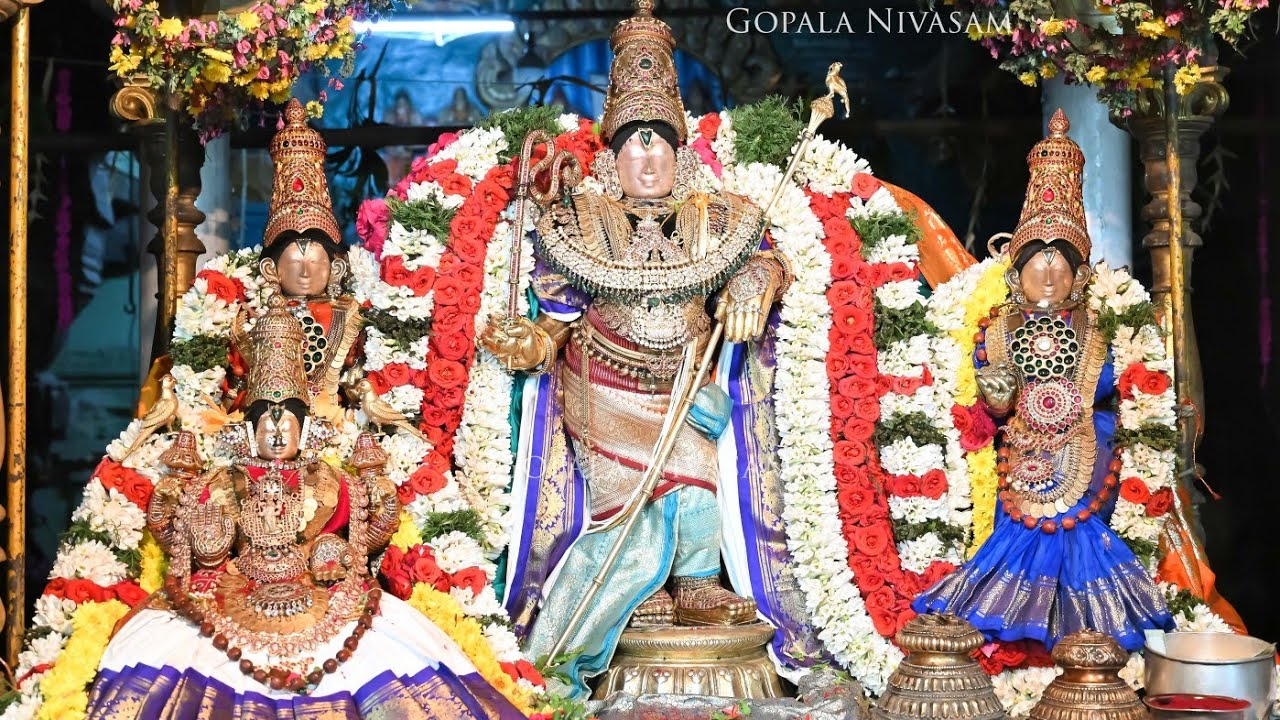
In the above picture of a serthi sevai on an oonjal (swing) you have seva of Rajagopala Perumal not only with his ubhayanachiyars Rukmini and Sathyabhama, but also Sri in the main Thayar mode, Sengamalavalli Thayar. The utsavar Perumal has the name Vidya Rajagoplan, abbreviated affectionately to Rajamannar or Rajagopalan.
Like in Tirumala and Srirangam temples, thengalai (southern school)) temple rituals are followed in this grand shrine too, but like Venkatesa and Ranganatha, our royal cowherd Rajagopala too is a darling of all Vishnu bhaktas. Swami Desika (northern school) as well as Manavala Mamunigal (southern school) have composed Gopala vimsatis
( twenty-shloka prayers in praise of Gopala ) on this deity. While Manavala Mamunigal’s stotra gives some pointers that it is specific to the Mannargudi deity, Swami Desika’s stuti is more general and is believed by some to have in mind the Rajagopalan deity at Tiruvahindrapuram, where Swami Desika lived for many years A moving shloka in Swami Desika’s stotra reflects the deep desire of every Vishnu bhakta that in his last moments he will be granted a vision of the divine cowherd, in the following lines
अधराहितचारुवंशनाळाः
मकुटालम्बि मयूरपिञ्छमालाः |
हरिनीलशिला विभङ्गनीलाः
प्रतिभाः सन्तु ममान्तिमप्रयाणे ||
May the glorious look of the bamboo flute held charmingly at the lips, the peacock feather plumes fixed elegantly atop the tresses and the beautiful blue hue of Gopala defying Harineela gems in loveliness, stay with me on my last journey! The Gopala in this beautiful word picture is not complete without the flute held to his mouth and played divinely.
Therefore devotees would like to visit Venugopala in his shrine, not just Gopalakrishna or Rajagopala, as often as possible so that the composite image created by Swami Desika can be memorized first and then recalled by them in their last moments. This is perhaps why Bhagavan directed the Hoysalas, Chalukyas and following them, the Vijayanagara kings and the kings of Tamil country, to build quite a few temples for Venugopala in Karnataka and neighbouring regions speaking Telugu and Tamil.
New temples have since come up all over South India for Venugopala. Whether the main deity is four-armed or two-armed, whether he has any Nachiyars standing next to him or not, his image should lead the devotee in his last moments to blissful liberation. I shall restrict myself to looking at a few temples (not all) featuring Rukmini and Satyabhāmā as ubhayanachiyars.
Before the brief tour let me recall Bhīṣma’s dhyanashlokam once again. We get to know that Bhīṣma was meditating on Krishna rather than on Vishnu per se only when we reach the last line. The last line introduces the Krishnavataramukhyamahishis before mentioning Krishna himself.
Thus Bhīṣma points to the form of Sri Bhu sameta bhagavan in Krishnavatara as our necessary ultimate guide to reach his feet. Millions of Vishnu bhaktas faithfully reciting Vishnu Sahasranama since the beginning of Kaliyuga may not have become aware of this to Bhīṣma’s satisfaction.
Great devotees of Krishna have performed pilgrimages to Mathura, Dwaraka, Srinathdwara, Pandharpur, Puri, Udupi, Guruvayur and also Krishna temples in Tamilnadu. Bhagavatam, Vishnu Puranam, and the Srisuktis of Azhvars and Acharyamahaneeyas have taught devotees the bliss and the benefits of Harinamabhajana.
Neela sameta bhagavan worship through satsangs and bhajans has focused on Ma Radha’s primacy among some groups who sing joyfully and perform her marriage to Krishna at least once every year in several locations. Radharani is Krishna’s unique consort in Gaudiya sampradaya’s Krishna Consciousness.
But, the two chief nachiyars of Krishna, recommended by the Kurupitamaha had not received enough attention through public participation in temple worship right up to the 10th century CE. From the third line to the fourth in his dhyāna shloka, from the position of Vaikunthapati to that of Yadavakrishna, the link through Nanda Gopala had to be reestablished, as that is how Krishna spent the earlier part of his advent on earth.
Rukmini and Satyabhāmā have to become nachiyars to the flute playing cowherd dancer, Navaneetakrishna, about whom Swami Desika wrote, also in Gopalavimsati thus.
आविर्भवत्वनिभृताभरणं पुरस्तात्
आकुञ्चितैकचरणं निभृतान्यपादम् |
दध्ना निमन्थ मुखरेण निबद्ध तालं
नाथस्य नन्दभवने नवनीतनाट्यम् ||
May the butter dance leela of my Lord Gopala that took place in Nanda’s palace, with his garlands moving in step to the apt soundbeats of curds being churned, with one leg bent and the other foot planted firmly on the ground unfold before me!
We can find comfort in the thought that Bhishmapitamaha can now feel satisfied that the aim of his dhyāna shloka has now been realized by the rise of about one hundred new Venugopala shrines, in many of which Rukmini and Satyabhāmā feature as ubhayanachiyars.
From the travel notings of Veludharan, we learn about the ancient Hoysala temple for Sri Venugopalaswamy at Thondanur called Thonnur these days.

Sri Ramanujacharya stayed in Thondanur for 12 years while the first of five Nārāyaṇa temples, the one meant for Lord Nambi Nārāyaṇa was being built here by King Vishnuvardhana, a Hoysala king whom the Acharya could persuade to follow Vaishnava
Way of life. Thereafter the Acharya moved to Melukote. It is believed that during this period at Thondanur, Sri Ramanuja stayed at the Hoysala temple premises. The moolavar Sri Venugopalaswamy here is accompanied by his consorts Rukmini and Satyabhāmā.
During the construction of the Krishnarajasagar dam in the beginning of the twentieth century, the village of Kannambadi which also contained a magnificent Hoysala style temple for Venugopalaswamy with Rukmini and Satyabhāmā as consorts, got completely submerged in the waters.
To house the displaced people, the Maharaja of Mysore had arranged the establishment of a new settlement called Hosakannambadi around 1 km from the dam site. Before the commissioning of the dam, the vigraha of Sri Venugopalswamy alone had been taken from the old temple and carefully preserved in the new village.
In a remarkable feat of preservation, the Khoday Foundation took up the task of relocating and reconstructing the temple in 2000. The structure was carefully rebuilt stone by stone at Hosa Kannambadi. Today, it stands as a breathtaking example of devotion meeting architectural excellence.

Sri Krishnaraja Pura Agrahara (S.K.P. Agrahara), old Sosale, is a small village on the eastern bank of the river Cauvery. It is thirty-two kilometers from Mysore, Karnataka. You can see below, the murtis of Sri Venugopala (chaturbhuja as he seems to have appeared in Bhīṣma’s dhyāna) and his ubhayanachiyars, Rukmini and Satyabhāmā in the 400 year old Srinivasa Venugopala Swamy temple, which has been renovated about a decade ago by the Sosale Srinivasa Seva Samithi.
The main deity in the temple is Srinivasa Perumal.

We see at Tirupati too a temple built in the 14th century, nearly two hundred years after Ramanujacharya had wished it to be constructed. Sri Venugopalaswamy is here too
accompanied by his consorts Rukmini and Satyabhāmā.

We had earlier referred to the sanchara Navaneeta Krishna of Ahobila Math, called Dolai Kannan. This Math follows the teachings of Sri Ramanuja and Swami Desika and is led by the line of monks known as Azhagiyasingars. It belongs to the Vadakalai or Northern school of Vaishnavite practice.
My Acharya of highly revered memory, the 45th Azhagiyasingar got a second image of Dolai Kannan made about 12 years ago and personally attended to the pranapratishtha, This Murti was sent to the USA and Dolai Kannan is now doing the rounds among Bhaktas in North America.
The vigraham set (sacred idol) of Sri Rukmini Satyabhāmā Sametha Sri Venugopalaswamy, which serves as the primordial worship deity (Aradhana Perumal) of the Srirangam Srimad Andavan Ashramam, also travels with the reigning Srimad Andavan and visits the home of devotees, where Srimad Andavan conducts dolotsavam and also delivers an anugrahabhashanam.
Sri Venugopalan was originally worshipped by Srimad Thirukkudanthai Andavan (Sri Gopalarya Mahadesikan, 1700–1780 CE. After his attaining Paramapada, the sacred vigraham was preserved and worshipped in private domestic aradhana by a devout family who safeguarded it for nearly two centuries.
In the 1970s, the family who had been preserving the idol handed it over to Srimad Thirukkudanthai Andavan (Sri Srinivasa Ramanuja Mahadesikan), the 8th Acharya of the Srirangam Srimad Andavan Ashrama. The handing over was effected through the good offices of a great devotee then residing in Sosale, who was later to become the 9th Acharya with the name Mysore Andavan.
Since its handover, the vigraham has been enshrined as the primary dolai and tiruvaradhana deity of the Ashramam, traveling with the reigning Srimad Andavan Acharya during daily worship and spiritual tours. Considering that the highly respected and loved Munitraya saint, Tirukkudanthai Andavan, travelled the length and breadth of our land on foot, reminding his followers and others how Bhagavan had not hesitated to keep walking for sadhu-paritrana and Dushkrit-vinashana during his Rama and Krishna avataras, the Rukmini-Satyabhāmā sameta Sri Venugopala deity too must have blessed millions of Bharatiyas all along the sacred trail!
The picture below is part of a post in Facebook by one of its devotees about the anugrahabhashanam from the present Acharya, during dolotsavam of the sanchara murtis at his house. You are able to have the darshan of the present Acharya as well as the sancharamurtis in the post.

Sancharamurtis similar to these as well as the image of Sri Bhashyakarar, namely Srimad Ramanuja, were arranged to be made, consecrated and sent to USA by a previous Srimad Andavan, namely Sri Ranga Ramanuja Desikan a few years ago. Sri Sunder Kidambi of www. prapatti.com confirmed to me by mail that this Sancharamurti is indeed blessing devotees around the USA, and has not been established in a specific shrine there. This is enabling fulfilment of Bhīṣma’s hope for Vaishnavas, even in far away North America!
I have been living in Bangalore for more than three decades and have enjoyed visiting the Venugopalaswamy temple at Malleshwaram a number of times. Sri Venugopala is the main deity with Sridevi and Bhudevi as ubhayanachiyars. Nambi Nārāyaṇa, Periya Piratti, Andal, Navaneetakrishna, Sita Lakshmana sameta Sri Ramachandra, Sri Anjaneya, Ramanujacharya, Vedanta Desika and Manavala Mamuni all have their Sannidhis in this popular place of worship.
I was born just a little less than ninety years ago in a town named Palayamkottai in the Tirunelveli district of Tamilnadu. Very close to this town, in a small village named Kizhanatham, Sri Venugopala has been enchanting devotees for approximately the same duration as he has been doing in Srirangam Srimad Andavan Ashrama. Some
Srivaishnava families of Velamur in South Arcot had migrated in the 18th century to Kizhanatham. My great grandmother Sundari Ammal, whom all her descendants affectionately called by the nickname Manniamma, had been born there to Sri Varada Iyengar and his wife Seemachamma around 1880 CE.
She married Sri Tirumalai Iyengar of nearby Gopalasamudram village and raised a large family in which generations crossed one another. Thus a grandson of hers was born in Gopalasamudram on the same day as I was born in Palayamkottai. I seek the pardon of my readers for this autobiographical sketch which I have used to introduce Kizhanatham.
I was able to visit this village again when my wife’s younger sister was joined in wedlock with a hydrogeologist named Gopala Rengarajan, son of the pannaiyaar of the village agrahara, Sri Gopala Srinivasan. Male members of their family had always been named with the prefix Gopala, and Rengarajan once told me that whenever harvested paddy was measured in nazhi or kuruni marakkals in their household, they used to start the count with Gopala, Gopala, three, four, five……, affirming their devotion to Venugopala Perumal.
The Perumal temple was at the western end of the agraharam, where he reigned with his consorts Rukmini and Satyabhāmā.
The temple has ancient roots with centuries of history and traditional links to Tiruppulingudi, one among the Nava Tirupathis in the Pandya region. The friendly links continue notwithstanding the Azhvar Tiruppati Perumal not being a Krishna, not in standing posture and not Vadagalai like in Kizanatham. The yatis of Srimad Andavan Ashram, who are fond of doing mangalashasanam to Perumal at the Azhvar navaTirupati shrines are equally happy to visit Sri Venugopala at Kizhanatham.
The Tamraparni river, which is the only perennial river in the south of India thanks to its geographic features and the monsoon intensity where it originates, drains an area of nearly 4,400 square kilometres, with most catchment zones lying within the Western Ghats, making it flood prone during intense northeast monsoon rainfall.
In living memory, major floods occurred in 1992, 2015 and December 2023, when discharge peaked around 4.5 lakh cubic feet per second, severely affecting Tirunelveli, Palayamkottai, Eral and Athoor regions. The effect of earlier floods on Kizhanatham after the Velamur Vaishnavites had arrived may not have been recorded effectively.
The previous name of Kizhanatham, Vellakkovil, meaning Flooded temple may actually be indicative and rather suggestive of the frequency of such events. The most recent, comprehensive renovation and the confidence with which samprokṣaṇam was carried out in 2024, a full 46 years after the previous one, should give rise to the hope that we can stop using the old name Vellakkovil!
The temple is in an excellent condition now. The presiding deity (Moolavar), Sri Venugopala, is uniquely sculpted in a tribhaṅgī posture (three-bend pose) playing the flute, flanked by His consorts Rukmini and Satyabhāmā. Unlike in other Venugopalaswamy shrines, the presiding deity has his head tilted backwards, in a fully absorbed mode of flute rendition which is not seen elsewhere.

There are separate Sannidhis for Sengamalam Thayar (Goddess Lakshmi), Yoga Narasimhar, Chakratazhwar, Andal, Garudazhwar, and the Azhwars/Acharyas (including Swami Nammazhwar, Periazhwar, Srimath Ramanujar/Bhashyakarar, and Swami Desikan).
Early migrants are believed to have experienced the ambience of Mathura (Vadamadurai divyadesam) in this village. To them, the Tamraparni river was the Yamuna. The hillock on the Eastern side became Govardhanagiri. The garden to the West became Brindavan.
अग्रे गोवर्धनाख्यो गिरिरिव सुमहान् पर्वतो दृश्यतेSसौ
पश्चात् भागे च बृन्दावनसदृशवटश्चायमन्दोर्मि वातः |
वामे ताम्रा सुपर्णी प्रवहति यमुनां ज्ञापयन्त्येव संयक्
ग्रामे श्रीकृष्णनृत्ते विहरतु सततं वंश्य रामानुजच्छविः ||
The above shloka was found by my nephew Bhavanesh Rengarajan in Tamil script in a copy of the invitation to attend the samprokshana of the temple held in 1978. My cousin Andal Raghavan deciphered it for me from the old, somewhat faded copy.
The utsava deities, whom you see in the picture below from left to right, are Sengamalam Thayar, Rukmini Nachiyar, Venugopala Perumal, Satyabhāmā Nachiyar and Andal Nachiyar.

Karnatakadesa welcomed Sri Bhashyakarar, when he visited it to escape the ill treatment meted out in Tamil Nadu to Srivaishnavas by a misguided Chozha king. While bringing Vishnu bhakti to a Hoysala king and many of his subjects, perhaps Sri Ramanuja also enjoyed the Hoysala mores of Vishnu worship, which included worship of the Gopala manifestation of the Lord in a big way.
This could have catalyzed the development of many Venugopala temples in South India. As exemplified at Kannambadi and Kizhanatham, the Bhaktas had been enabled by the strength and sincerity of their devotion to fight floods, natural or man-made, to save the abodes of Venugopala!
No reflections yet. Be the first to share your thoughts!