Yet the moment light breaks free, something strange happens to time.
From Earth, we clock its journey across the void at eight minutes and twenty seconds. Yet, according to Einstein’s relativity, in the geometry of four-dimensional spacetime, the interval along that ray of light is precisely zero. A photon has no rest frame, no ticking clock of its own.
The journey that we measure in minutes, years, or even millennia entails no passage of proper time along its path.
Zoom down to the level of quantum field theory, and things get even more interesting. A photon is not a tiny marble spit out by a distant star; it is an excitation—a ripple—in the electromagnetic field that permeates the universe.
Now, indulge a thought experiment. Let us venture beyond the domain of physics and into that of the imagination: what if the Sun were conscious—and its photons were, too?
The Intoxication of the "Out There"
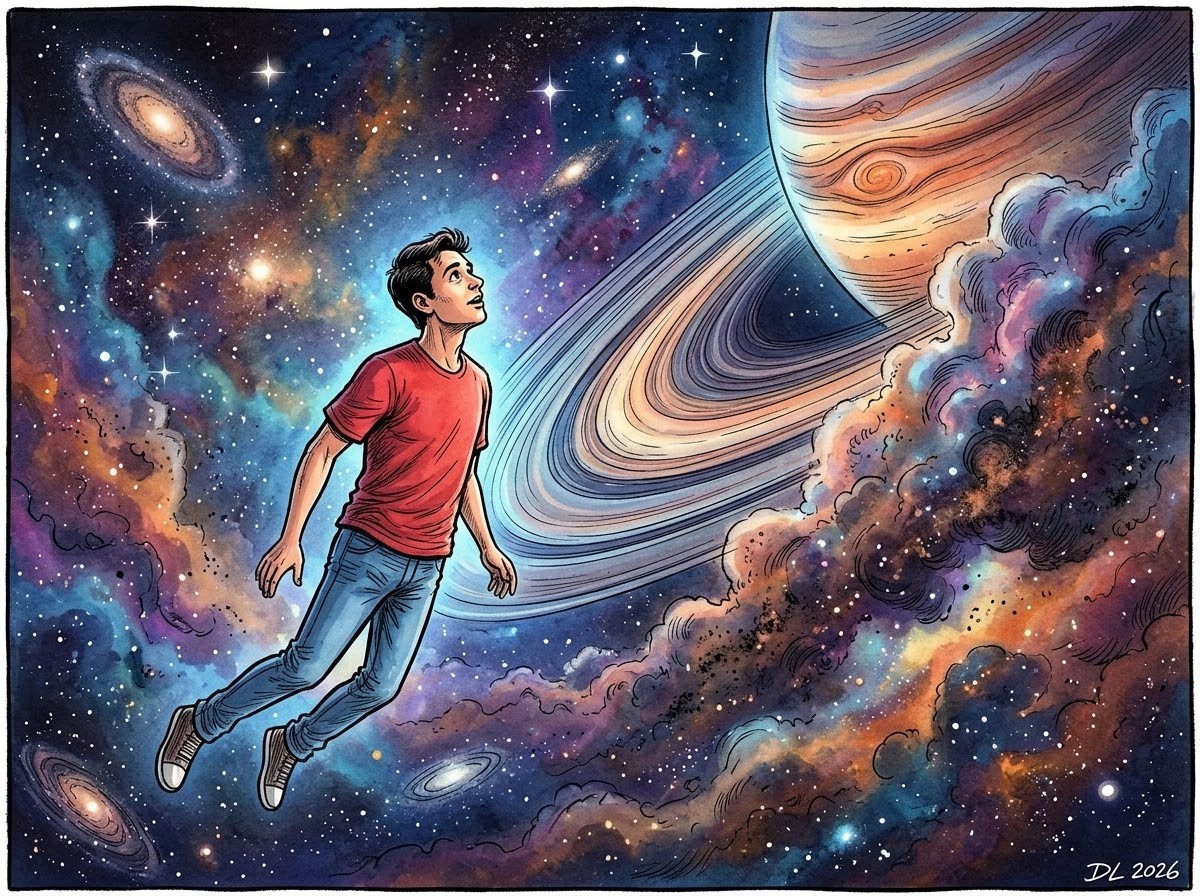
Imagine a single photon rippling outward through spacetime.
In the beginning, it is utterly captivated by the scenery. Looking outward, it takes in the swirling rings of gas giants, the silver dust of nebulae, and the vast expanse of interstellar space. The longer it "travels," the more engrossed it becomes in the spectacle of the out there.
Gradually, the memory of the blinding furnace behind it recedes. It stops experiencing itself as an expression of the Sun and begins to think of itself as a solitary traveler moving through an endless expanse.
Eventually, exhaustion sets in. It grows weary of the relentless motion and decides it would like to rest for a while—to pull over, sit on the edge of a comet, and catch its breath.
The trouble is that light has no brakes.
By the laws of the cosmos, a photon cannot simply coast to a halt. Its very existence is the going. Even as the expanding universe stretches its wavelength—redshifting its brilliant ultraviolet light into visible light, softening it into infrared, and eventually into radio waves—it continues to propagate at the speed of light.
It can change in frequency, but it cannot decide to stop and take a break.
The Birth of Prayer

Unable to stop the outward rush, the weary photon does the only thing left to it: it turns inward, into its own consciousness.
Closing its eyes to the passing galaxies, it remembers its parent—the Sun—and the overwhelming, luminous brilliance from which it emerged. Convinced that it is a small, separate being cast out into a cold universe, it begins to meditate on that distant splendor. It prays to its creator for the strength to carry on its photonic life to the best of its ability, trusting that if it remains faithful, bliss will await it at the end of the journey.
Somewhere in the long history of its wanderings, it had learned of a sacred invocation through which it could reconnect with the Sun and be illuminated by the grace of its maker.
Now, in the silence of its inward gaze, the photon invokes one of humanity’s most ancient solar hymns—the Gāyatrī mantra:
| Oṃ bhūr bhuvaḥ svaḥTat savitur vareṇyaṃBhargo devasya dhīmahiDhiyo yo naḥ pracodayāt |
|---|
It calls out across the planes of existence—earth, atmosphere, and the heavens—fixing its awareness on Savitṛ, the radiant Source, and praying that its divine effulgence might illuminate its intellect.
And for a while, it works.
The Pendulum of Practice
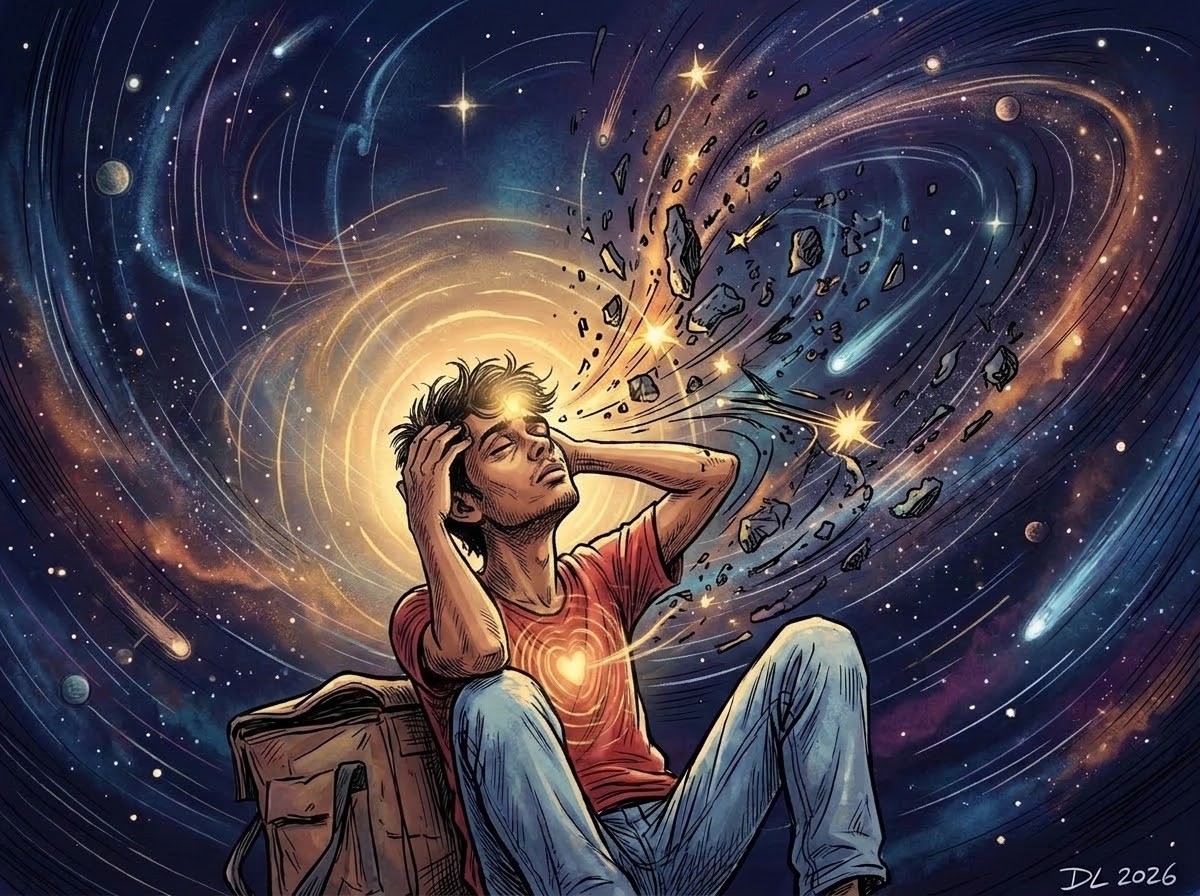
Held within the resonance of the mantra, the photon enters a state of breathtaking clarity and illumination. The dark no longer feels hostile; the endless flight no longer feels like a burden. It rests in a quiet certainty of its connection to the Source.
Until something shimmers in its periphery.
You do not undo an eternity of momentum in a single afternoon. Looking outward is not merely something the photon did; it has become a deep-seated habit. A passing dust cloud catches its attention, a new star system wheels into view—and snap. The old reflex kicks in before the photon even realizes what is happening.
It gets distracted, slips out of its stillness, and tumbles right back into the old ache of separation.
Now, however, there is a new friction: it knows what it has lost.
So the photon becomes a disciplined spiritual seeker. It establishes a daily practice of meditation. It turns inward, invokes the mantra, and charges itself up—only to become engrossed in the scenery and seemingly discharge itself again.
Clarity, distraction, forgetting, remembering, returning.
Over and over it oscillates between these states. And despite all its devotion and spiritual practice, it cannot shake the quiet despair that with every passing light-year, it is drifting farther and farther away from home.
The Crack in the Illusion

Then, in the middle of one rather ordinary meditation, a question arises—so simple, so obvious, that it brings the entire struggle to a halt.
Wait, the photon thinks. If the Sun is light, and when I am not "connected" to it, I get lost in the experience of the outside world… how does that world even manifest itself to me?
Surely, to see anything at all, there must be light.
In that instant, the whole architecture of spiritual distance collapses.
Every planet, every nebula, every glittering distraction it had spent eons trying to shut out—how had they ever appeared to it in the dark?
What had been illuminating them?
Its own light!
The photon had never been discharged. It had never been severed from the Sun or plunged into darkness. It had simply been illuminating the scenery and, in becoming engrossed in the experience thereof, had come to believe that the scenery was somehow depriving it of its radiance.
And what of those countless moments of ignorance, despair, and forgetfulness? Had they not been illuminated by the very same light? What else could have made the photon aware of its experience of being lost?
Even its experience of separation had been made possible by that from which it imagined itself to be separated.
There was never a dark "outside" competing with a bright "inside." Even in its most distracted, weary, and forgetful moments, the very act of perceiving the cosmos was the Sun shining.
At Rest at the Speed of Light

With that realization, the long, exhausting comedy of the search comes to an end.
The photon sees that it was never a small, solitary spark trying to stay plugged into a distant furnace. It is the light itself.
Light is because it is; it is because light is.
The distinction between the seer, the seeing, and the seen dissolves into a single, unbroken radiance.
The strangest part is that nothing on the outside changes. The ripple still races across spacetime without brakes. Galaxies still wheel past, dust clouds still shimmer, and worlds still turn in the dark.
Yet everything is different.
Looking outward is no longer a fall from grace, because there is no longer an "outside" to fall into. When its gaze touches a moon or a distant shore, it is no longer getting distracted—it is simply light, delighting in the infinite forms it illuminates.
It may still invoke the Gāyatrī, but no longer out of a sense of separation. It may still turn inward, but not because there is anything fundamentally different to be found there. What it once did out of a longing to become whole, it can now do out of the sheer joy of being.
There is nothing to replenish, nothing to sustain, and no distance to traverse in order to get home.
Moving at the speed of light, the photon is finally, completely at rest—no longer a traveler trying to remember the Sun, just the Sun, playing in the open.

No reflections yet. Be the first to share your thoughts!